
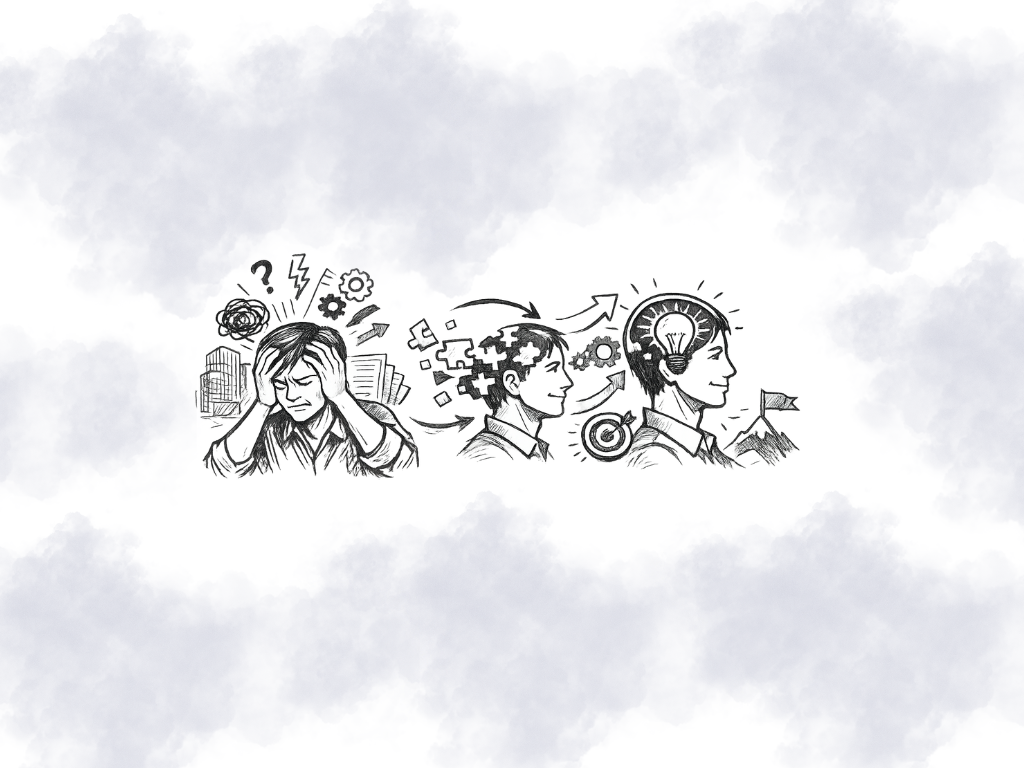
First things first: change and transition are not the same thing.
We use them interchangeably, but they’re actually two very different beasts.
Change is situational. It’s external, observable.
Examples:
- Scale-up,
- Merger or acquisition,
- Restructuring,
- “Strategic reorganization” (everyone’s favorite euphemism),
- New roles,
- New leadership and reporting lines,
- Different strategy,
- Fewer people, more responsibility.
Change is the event.
Transition is psychological. It’s internal, messy, emotional.
Transition is the process your brain, identity, habits need to go through to catch up with the change.
Change can happen overnight. Transition cannot.
Why “resistance to change” is often misdiagnosed
When employees push back, disengage, or seem unmotivated, leaders can label it as:
- lack of buy-in
- rigid mindset
- low resilience.
More often, what you’re seeing is unprocessed loss. Because organizational change comes with endings.
Based on the brilliant book “Managing transitions” (by William Bridges), before employees can embrace something new, something old has to end. In organisational changes people may be losing:
- familiar ways of working
- trusted colleagues or managers
- autonomy
- status
- a sense of competence
- the culture they signed up for
Even when the change is positive, loss is still loss.
That’s why reactions can seem disproportionate. But when people “overreact”, it’s often because the loss hasn’t been acknowledged.
Ignoring endings doesn’t make people more adaptable. It just creates resistance.
People need the time to process the ending.
Then comes the messy middle, or neutral zone.
This is the phase most organizations underestimate.
The old system no longer works. The new system isn’t fully clear or stable yet.
Employees think:
- “What’s actually expected of me now?”
- “Do I still belong here?”
- “Will I be successful in this new setup?”
- “Is this going to work… or change again in 6 months?”
In the neutral zone:
- productivity dips
- confidence wobbles
- people second-guess leadership
- rumors spread faster.
And yet, the neutral zone is not a failure of leadership. It’s a necessary reorientation phase.
Handled well, it’s where:
- innovation happens
- outdated practices are questioned
- teams redefine how they work together.
Then comes the new beginning. A new beginning is not the launch date.
It’s the moment when people:
- understand the why behind the change
- see how their role fits
- experience early wins
- start identifying with the new reality
The new beginning in a transition requires more than a presentation in a town hall meeting. It requires:
- clarity (“What does good look like now?”)
- consistency (leaders modeling the change)
- involvement (people having a real role to play)
- reinforcement (what gets rewarded gets repeated)
Without it, people comply, but don’t commit.
The leadership blind spot
Change management focuses on outcomes. Transition management focuses on people.
And people are not behind just because they haven’t emotionally caught up yet.
They’re transitioning.
If you’re leader or HR in an organization that’s going through significant organisational change, I recommend reading “Managing transitions” and asking yourself:
- What are people being asked to let go of and start doing?
- What support are we providing for their psychological transition?
When transitions aren’t managed resistance increases, anxiety spreads, performance drops and trust erodes. And the results of the company suffer.
But when they are managed well, people grow through change.
And that’s when organizational change actually sticks.
